Driving Licence in Germany: Everything You Need to Know A driving licence is an important...
Weiterlesen


Driving Licence in Germany: Everything You Need to Know A driving licence is an important...
Weiterlesen
Rijbewijs kosten in Duitsland: een compleet overzicht Wie in Duitsland zijn rijbewijs wil halen, vraagt...
WeiterlesenTaking the German driving test is one of the most important steps toward obtaining a German driving licence. Whether you are a first-time driver, an international student, an expatriate or a foreign resident planning to drive in Germany, understanding the examination process can help you prepare more effectively.
Germany has a structured licensing system that tests both theoretical knowledge and practical driving ability. For most applicants seeking a first driving licence, both examinations are required. The German Fahrerlaubnis-Verordnung (FeV) establishes the examination requirements, while the detailed examination procedures are set out in Annex 7.
In this guide, we explain how the German driving test works, what you need to learn, how the theory examination is structured, what happens during the practical test, common mistakes, retake rules and the best ways to prepare.
For more information about obtaining a German driving licence, visit FahrenExperten.
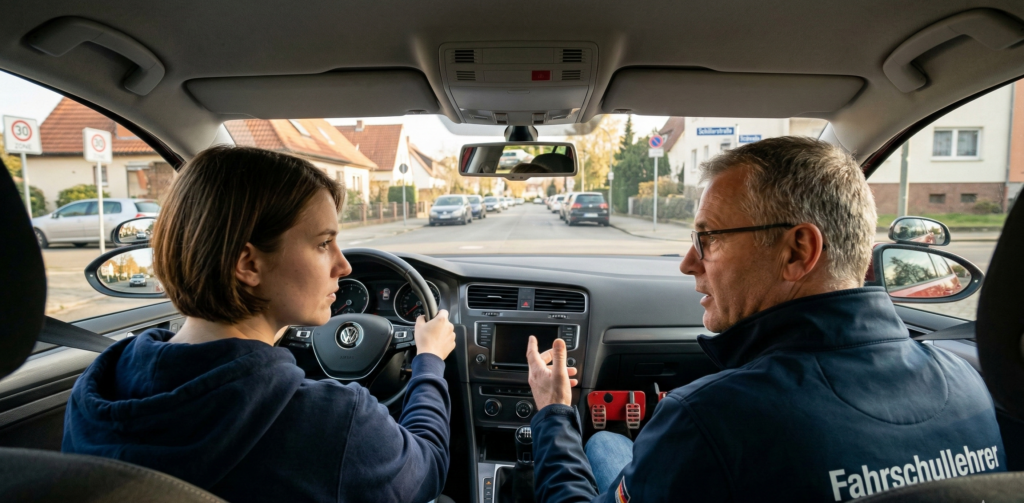
The German driving test is the official examination used to determine whether an applicant has the knowledge and practical skills necessary to drive safely.
For most first-time applicants, the process consists of:
German law states that applicants generally demonstrate their competence through both a theoretical and practical examination. Certain licence categories and extensions are exceptions. For example, obtaining a Class L licence requires only a theory examination, while some licence extensions require only a practical examination.
The examinations are conducted by an officially recognised examiner or assessor for motor vehicle traffic.
The theory examination is the first major stage of the German driving test for most applicants.
It is designed to establish whether you understand the rules and principles necessary for safe driving.
According to Section 16 of the FeV, the theory test assesses knowledge of:
This means that successful preparation involves more than memorising road signs.
You need to understand how German traffic rules work and how to apply them to real-life situations.
For a first-time applicant for Class B, as well as several other licence categories, the standard theory examination contains 30 questions.
The examination has:
However, there is an important exception: answering two questions worth five points each incorrectly results in failure, even if the total number of error points would otherwise be within the permitted limit.
This makes it important to understand high-value questions rather than simply counting how many questions you get wrong.
The theory examination covers a broad range of subjects.
You should be prepared for questions about:
You need to recognise and understand warning, regulatory, mandatory and informational signs.
Priority rules are an essential part of German road traffic.
Questions can address speed limits, appropriate speed and adapting speed to road conditions.
You should understand standard traffic signals and how they interact with other traffic rules.
German traffic regulations contain specific rules governing where and when vehicles may stop or park.
You should know when overtaking is permitted and when it is prohibited.
Motorway rules, lane discipline, stopping restrictions and safe speeds are important areas of knowledge.
The theory test can also assess basic technical knowledge relevant to road safety.
Environmentally conscious and energy-efficient driving is specifically included in the examination requirements.
For additional study resources, explore our Führerschein Test content.
Yes.
This is particularly useful for international residents who are still learning German.
The official examination rules allow the theory examination to be taken in several foreign languages, including English. Other permitted languages include French, Greek, Italian, Polish, Portuguese, Romanian, Russian, Croatian, Spanish, Turkish and Standard Arabic.
This makes the German driving licence system more accessible to many international applicants.
However, learning important German road-traffic terminology can still be useful because you will encounter German signs, road markings and instructions during practical driving.
If you are studying in English, see our German Driving Licence resources for additional information.
Good preparation is essential.
Your driving school provides structured instruction covering the relevant examination subjects.
Do not rely exclusively on memorising answers. Understand why particular rules exist.
Repeated practice helps you become familiar with question structures and common scenarios.
Because questions carry different point values, mistakes on five-point questions can have a significant impact.
Make sure you can identify signs quickly and understand their implications.
Learn how factors such as speed, visibility, weather and road conditions influence risk.
Do not schedule the examination until your practice results are consistently strong.
Passing the theory examination is only part of the German driving test.
The practical examination assesses whether you can safely operate a vehicle in real traffic.
German law requires the applicant to demonstrate the technical knowledge and practical ability necessary to safely operate the vehicle, together with appropriate environmentally conscious and energy-efficient driving.
The exact examination requirements depend on your licence category.
For a standard car licence, the examiner may assess your ability to manage real-world traffic situations, vehicle control and prescribed driving tasks.
The practical examination can involve several components.
Depending on the licence category and examination requirements, these may include:
The detailed examination structure is established in Annex 7 of the FeV and the applicable examination guidelines.
The examiner is not simply checking whether you can make the vehicle move.
The objective is to determine whether you can drive safely, independently and in accordance with German traffic regulations.
Important areas include:
You should regularly and correctly check:
You must choose an appropriate speed based on:
Your position within the lane should be appropriate to the road and traffic situation.
You need to correctly recognise and respect priority rules.
Use indicators correctly when changing direction, changing lanes or carrying out other relevant manoeuvres.
You should demonstrate smooth and controlled use of:
The practical test cannot normally be taken before passing the theory examination.
Section 17 FeV explicitly provides that the practical examination may only be conducted after the theory examination has been passed. It may also be taken no earlier than one month before reaching the applicable minimum age.
This means your preparation should follow a logical sequence:
Theory training → Theory test → Practical training → Practical test
Passing the theory test does not give you unlimited time to complete the practical examination.
Under Section 18 FeV, the practical examination must generally be completed within 12 months after passing the theory examination. Otherwise, the theory examination loses its validity.
This is an important deadline for candidates.
Once you pass the theory test, work with your driving school to maintain sufficient practical training and arrange the practical examination within the applicable period.
Failing the German driving test does not mean that you have lost your opportunity to obtain a driving licence.
You can normally prepare for another attempt.
German regulations provide that a failed examination generally cannot be repeated before an appropriate waiting period, normally at least two weeks.
However, simply taking the test again without addressing the reason for failure is rarely the best strategy.
Instead, identify exactly what went wrong.
For example:
Failing to recognise who has priority can create serious safety risks.
Insufficient mirror or blind-spot checks are common problems.
Driving too fast for the circumstances can be dangerous even when you are below the posted maximum speed.
Poor positioning can make manoeuvres and interactions with other road users unsafe.
Incorrect or missing indicators can demonstrate inadequate communication with other road users.
Stalling, harsh braking or poor steering control can affect the assessment.
You need to demonstrate control and observation when parking.
Nervousness is normal, but it should not prevent you from observing the road and making safe decisions.
There is no guaranteed shortcut to passing.
The most effective approach is structured preparation.
Regular lessons help develop stable driving habits.
Ask your instructor to explain exactly what you did wrong and how to correct it.
Spend additional time on areas where you are less confident.
Mirror checks and blind-spot checks should become natural parts of your driving routine.
Good drivers identify potential problems before they become emergencies.
Do not rely on your instructor to tell you what to do at every stage.
Do not rush because you are nervous.
Safe and deliberate decisions are generally more important than trying to drive quickly.
For additional preparation, explore our Practical Driving Test guide.

Foreign residents often face an additional challenge: understanding German traffic rules while adapting to a different driving environment.
If you are an international applicant, pay particular attention to:
If you already hold a foreign driving licence, however, you should first determine whether you actually need to complete the full German examination process.
Depending on your country of licence issuance and circumstances, recognition or exchange may be possible.
Read our Foreign Driving Licence Germany guide before starting a new licence application.
If you hold a valid driving licence issued by an EU or EEA country, different recognition rules can apply.
Moving to Germany does not automatically mean that you need to take the German driving test again.
The applicable rules depend on the licence, category and individual circumstances.
If you already have an EU driving licence, investigate the recognition rules before enrolling in a complete German driving course.
You can learn more in our EU Driving Licence guide.
The situation can be different for licences issued outside the EU/EEA.
Depending on the issuing country, German rules may allow a foreign licence to be exchanged with no examination, while other situations can require a theory test, practical test or both.
Therefore, applicants should not assume that every foreign licence requires the full German driving test.
For more information, read our Führerschein Umschreiben Deutschland guide.
The cost of obtaining a German driving licence varies considerably.
Expenses can include:
Your total cost can therefore be significantly higher if you require many additional driving lessons or have to repeat an examination.
Read our Führerschein Kosten and Führerschein Kosten 2026 guides for more information.
Use this checklist before your examination.
The German system places considerable emphasis on both theoretical knowledge and practical application.
The theory examination covers legal requirements, hazards, environmental driving and technical principles.
The practical examination then evaluates the ability to apply those principles safely on the road.
This is why applicants who already know how to drive in another country should not assume that their existing habits automatically meet German examination standards.
Learning the German rules of the road is just as important as learning vehicle control.
It can be challenging, particularly for applicants unfamiliar with German traffic regulations. Good preparation, consistent driving lessons and a strong understanding of road rules can significantly improve your chances of passing.
For a first-time Class B applicant, the standard examination contains 30 questions, with 110 possible points and generally a maximum of 10 error points. Two incorrect five-point questions result in failure.
Yes. English is one of the foreign languages permitted for the theory examination.
No. The practical examination generally requires the theory examination to have already been passed.
A failed examination generally cannot be repeated before the applicable waiting period, which is normally at least two weeks.
The practical examination generally must be completed within 12 months after passing theory.
Not necessarily. If you already have a foreign driving licence, recognition or exchange rules may apply depending on the licence and country of issue.
For a first German driving licence, examinations are generally required. However, specific foreign-licence exchange and licence-extension rules can create exceptions.
The German driving test is designed to ensure that drivers possess both the knowledge and practical competence required to participate safely in German road traffic.
For a typical first-time car applicant, the process can be summarised as:
Driving school → Theory training → Theory test → Practical training → Practical test → German driving licence
The theory test evaluates your understanding of traffic regulations, hazards, environmental driving and basic technical principles. The practical test then evaluates your ability to apply that knowledge safely in real traffic.
The best preparation is therefore not simply memorising test answers. Learn the rules, understand the reasoning behind them and practise applying them consistently.
If you are preparing for the German driving test, researching German driving licence requirements, or looking for information about theory and practical examinations, explore the full range German Driving Test: Everything You Need to Know
Taking the German driving test is one of the most important steps toward obtaining a German driving licence. Whether you are a first-time driver, an international student, an expatriate or a foreign resident planning to drive in Germany, understanding the examination process can help you prepare more effectively.
Germany has a structured licensing system that tests both theoretical knowledge and practical driving ability. For most applicants seeking a first driving licence, both examinations are required. The German Fahrerlaubnis-Verordnung (FeV) establishes the examination requirements, while the detailed examination procedures are set out in Annex 7.
In this guide, we explain how the German driving test works, what you need to learn, how the theory examination is structured, what happens during the practical test, common mistakes, retake rules and the best ways to prepare.
For more information about obtaining a German driving licence, visit FahrenExperten.
The German driving test is the official examination used to determine whether an applicant has the knowledge and practical skills necessary to drive safely.
For most first-time applicants, the process consists of:
German law states that applicants generally demonstrate their competence through both a theoretical and practical examination. Certain licence categories and extensions are exceptions. For example, obtaining a Class L licence requires only a theory examination, while some licence extensions require only a practical examination.
The examinations are conducted by an officially recognised examiner or assessor for motor vehicle traffic.
The theory examination is the first major stage of the German driving test for most applicants.
It is designed to establish whether you understand the rules and principles necessary for safe driving.
According to Section 16 of the FeV, the theory test assesses knowledge of:
This means that successful preparation involves more than memorising road signs.
You need to understand how German traffic rules work and how to apply them to real-life situations.
For a first-time applicant for Class B, as well as several other licence categories, the standard theory examination contains 30 questions.
The examination has:
However, there is an important exception: answering two questions worth five points each incorrectly results in failure, even if the total number of error points would otherwise be within the permitted limit.
This makes it important to understand high-value questions rather than simply counting how many questions you get wrong.
The theory examination covers a broad range of subjects.
You should be prepared for questions about:
You need to recognise and understand warning, regulatory, mandatory and informational signs.
Priority rules are an essential part of German road traffic.
Questions can address speed limits, appropriate speed and adapting speed to road conditions.
You should understand standard traffic signals and how they interact with other traffic rules.
German traffic regulations contain specific rules governing where and when vehicles may stop or park.
You should know when overtaking is permitted and when it is prohibited.
Motorway rules, lane discipline, stopping restrictions and safe speeds are important areas of knowledge.
The theory test can also assess basic technical knowledge relevant to road safety.
Environmentally conscious and energy-efficient driving is specifically included in the examination requirements.
For additional study resources, explore our Führerschein Test content.
Yes.
This is particularly useful for international residents who are still learning German.
The official examination rules allow the theory examination to be taken in several foreign languages, including English. Other permitted languages include French, Greek, Italian, Polish, Portuguese, Romanian, Russian, Croatian, Spanish, Turkish and Standard Arabic.
This makes the German driving licence system more accessible to many international applicants.
However, learning important German road-traffic terminology can still be useful because you will encounter German signs, road markings and instructions during practical driving.
If you are studying in English, see our German Driving Licence resources for additional information.
Good preparation is essential.
Your driving school provides structured instruction covering the relevant examination subjects.
Do not rely exclusively on memorising answers. Understand why particular rules exist.
Repeated practice helps you become familiar with question structures and common scenarios.
Because questions carry different point values, mistakes on five-point questions can have a significant impact.
Make sure you can identify signs quickly and understand their implications.
Learn how factors such as speed, visibility, weather and road conditions influence risk.
Do not schedule the examination until your practice results are consistently strong.
Passing the theory examination is only part of the German driving test.
The practical examination assesses whether you can safely operate a vehicle in real traffic.
German law requires the applicant to demonstrate the technical knowledge and practical ability necessary to safely operate the vehicle, together with appropriate environmentally conscious and energy-efficient driving.
The exact examination requirements depend on your licence category.
For a standard car licence, the examiner may assess your ability to manage real-world traffic situations, vehicle control and prescribed driving tasks.
The practical examination can involve several components.
Depending on the licence category and examination requirements, these may include:
The detailed examination structure is established in Annex 7 of the FeV and the applicable examination guidelines.
The examiner is not simply checking whether you can make the vehicle move.
The objective is to determine whether you can drive safely, independently and in accordance with German traffic regulations.
Important areas include:
You should regularly and correctly check:
You must choose an appropriate speed based on:
Your position within the lane should be appropriate to the road and traffic situation.
You need to correctly recognise and respect priority rules.
Use indicators correctly when changing direction, changing lanes or carrying out other relevant manoeuvres.
You should demonstrate smooth and controlled use of:
The practical test cannot normally be taken before passing the theory examination.
Section 17 FeV explicitly provides that the practical examination may only be conducted after the theory examination has been passed. It may also be taken no earlier than one month before reaching the applicable minimum age.
This means your preparation should follow a logical sequence:
Theory training → Theory test → Practical training → Practical test
Passing the theory test does not give you unlimited time to complete the practical examination.
Under Section 18 FeV, the practical examination must generally be completed within 12 months after passing the theory examination. Otherwise, the theory examination loses its validity.
This is an important deadline for candidates.
Once you pass the theory test, work with your driving school to maintain sufficient practical training and arrange the practical examination within the applicable period.
Failing the German driving test does not mean that you have lost your opportunity to obtain a driving licence.
You can normally prepare for another attempt.
German regulations provide that a failed examination generally cannot be repeated before an appropriate waiting period, normally at least two weeks.
However, simply taking the test again without addressing the reason for failure is rarely the best strategy.
Instead, identify exactly what went wrong.
For example:
Failing to recognise who has priority can create serious safety risks.
Insufficient mirror or blind-spot checks are common problems.
Driving too fast for the circumstances can be dangerous even when you are below the posted maximum speed.
Poor positioning can make manoeuvres and interactions with other road users unsafe.
Incorrect or missing indicators can demonstrate inadequate communication with other road users.
Stalling, harsh braking or poor steering control can affect the assessment.
You need to demonstrate control and observation when parking.
Nervousness is normal, but it should not prevent you from observing the road and making safe decisions.
There is no guaranteed shortcut to passing.
The most effective approach is structured preparation.
Regular lessons help develop stable driving habits.
Ask your instructor to explain exactly what you did wrong and how to correct it.
Spend additional time on areas where you are less confident.
Mirror checks and blind-spot checks should become natural parts of your driving routine.
Good drivers identify potential problems before they become emergencies.
Do not rely on your instructor to tell you what to do at every stage.
Do not rush because you are nervous.
Safe and deliberate decisions are generally more important than trying to drive quickly.
For additional preparation, explore our Practical Driving Test guide.
Foreign residents often face an additional challenge: understanding German traffic rules while adapting to a different driving environment.
If you are an international applicant, pay particular attention to:
If you already hold a foreign driving licence, however, you should first determine whether you actually need to complete the full German examination process.
Depending on your country of licence issuance and circumstances, recognition or exchange may be possible.
Read our Foreign Driving Licence Germany guide before starting a new licence application.
If you hold a valid driving licence issued by an EU or EEA country, different recognition rules can apply.
Moving to Germany does not automatically mean that you need to take the German driving test again.
The applicable rules depend on the licence, category and individual circumstances.
If you already have an EU driving licence, investigate the recognition rules before enrolling in a complete German driving course.
You can learn more in our EU Driving Licence guide.
The situation can be different for licences issued outside the EU/EEA.
Depending on the issuing country, German rules may allow a foreign licence to be exchanged with no examination, while other situations can require a theory test, practical test or both.
Therefore, applicants should not assume that every foreign licence requires the full German driving test.
For more information, read our Führerschein Umschreiben Deutschland guide.
The cost of obtaining a German driving licence varies considerably.
Expenses can include:
Your total cost can therefore be significantly higher if you require many additional driving lessons or have to repeat an examination.
Read our Führerschein Kosten and Führerschein Kosten 2026 guides for more information.
Use this checklist before your examination.
The German system places considerable emphasis on both theoretical knowledge and practical application.
The theory examination covers legal requirements, hazards, environmental driving and technical principles.
The practical examination then evaluates the ability to apply those principles safely on the road.
This is why applicants who already know how to drive in another country should not assume that their existing habits automatically meet German examination standards.
Learning the German rules of the road is just as important as learning vehicle control.
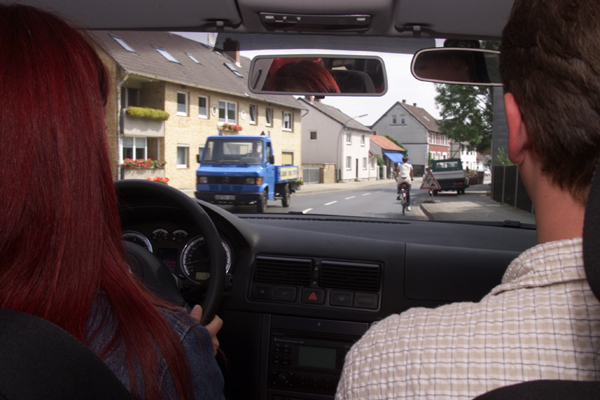
It can be challenging, particularly for applicants unfamiliar with German traffic regulations. Good preparation, consistent driving lessons and a strong understanding of road rules can significantly improve your chances of passing.
For a first-time Class B applicant, the standard examination contains 30 questions, with 110 possible points and generally a maximum of 10 error points. Two incorrect five-point questions result in failure.
Yes. English is one of the foreign languages permitted for the theory examination.
No. The practical examination generally requires the theory examination to have already been passed.
A failed examination generally cannot be repeated before the applicable waiting period, which is normally at least two weeks.
The practical examination generally must be completed within 12 months after passing theory.
Not necessarily. If you already have a foreign driving licence, recognition or exchange rules may apply depending on the licence and country of issue.
For a first German driving licence, examinations are generally required. However, specific foreign-licence exchange and licence-extension rules can create exceptions.
The German driving test is designed to ensure that drivers possess both the knowledge and practical competence required to participate safely in German road traffic.
For a typical first-time car applicant, the process can be summarised as:
Driving school → Theory training → Theory test → Practical training → Practical test → German driving licence
The theory test evaluates your understanding of traffic regulations, hazards, environmental driving and basic technical principles. The practical test then evaluates your ability to apply that knowledge safely in real traffic.
The best preparation is therefore not simply memorising test answers. Learn the rules, understand the reasoning behind them and practise applying them consistently.
If you are preparing for the German driving test, researching German driving licence requirements, or looking for information about theory and practical examinations, explore the full range of driving-licence resources available at FahrenExperten. driving-licence resources available at FahrenExperten.
Driving Licence in Germany: Everything You Need to Know A driving licence is an important...
Weiterlesen
Rijbewijs kosten in Duitsland: een compleet overzicht Wie in Duitsland zijn rijbewijs wil halen, vraagt...
Weiterlesen