Driving Licence in Germany: Everything You Need to Know A driving licence is an important...
Weiterlesen


Driving Licence in Germany: Everything You Need to Know A driving licence is an important...
Weiterlesen
Rijbewijs kosten in Duitsland: een compleet overzicht Wie in Duitsland zijn rijbewijs wil halen, vraagt...
WeiterlesenMoving to Germany with a foreign driving licence can make settling into your new life much easier. Whether you are moving for work, studying, joining family or establishing a permanent residence, understanding Germany’s driving licence rules should be one of your priorities.
The rules are not the same for everyone. A driving licence issued by an EU or EEA country is generally treated differently from a licence issued by a country outside the EU and EEA. For many non-EU/EEA licence holders, the foreign licence can generally be used for six months after establishing normal residence in Germany. After this period, a German driving licence is required if you want to continue driving.
This comprehensive guide explains the most important things you need to know about a foreign driving licence Germany, including recognition, conversion, deadlines, documents, examinations, costs and common mistakes.
For more information about German driving licences, visit FahrenExperten.
A foreign driving licence is a driving licence issued by a country other than Germany.
If you move to Germany with an existing licence, you should determine whether it is:
The classification matters because it determines how long you can drive in Germany and whether you eventually need to exchange your licence.
Germany’s Federal Portal specifically distinguishes between EU/EEA licences and licences from third countries outside the European Union and European Economic Area.
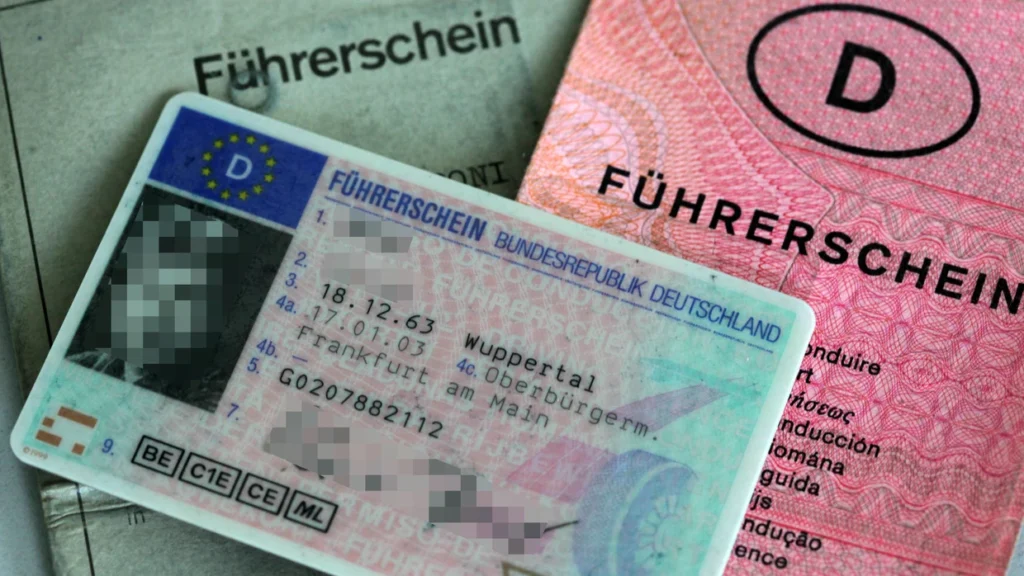
Yes, in many circumstances.
However, the length of time you can use your licence depends on your residence status and where the licence was issued.
For someone who does not have normal residence in Germany, a valid foreign driving licence can generally be used within the scope of the driving categories it authorises. Once normal residence is established, different rules apply.
If you have a non-EU/EEA driving licence and establish normal residence in Germany, the licence is generally recognised for six months.
After those six months, you need a German driving licence to continue driving in Germany.
If your foreign driving licence was issued by an EU or EEA country, the situation is generally more straightforward.
Valid EU/EEA licences for harmonised driving categories generally do not need to be exchanged immediately simply because you move to Germany.
This means that someone moving from another EU country can generally continue using their valid EU driving licence in Germany.
However, there are important exceptions involving certain licence categories and validity periods.
For categories that are subject to German time limits, German validity periods can apply even if the foreign licence contains a longer validity period or no expiry date.
If you are interested specifically in EU licences, see our EU Driving Licence Germany guide.
The situation changes when your licence was issued outside the EU/EEA.
If you establish normal residence in Germany, a valid non-EU/EEA driving licence is generally recognised for six months.
After six months, you must obtain a German driving licence if you want to continue driving.
This is one of the most important rules for anyone searching for information about a foreign driving licence Germany.
Imagine you move permanently to Germany and establish your normal residence there.
Your six-month period begins in connection with establishing that normal residence.
During the recognition period, you can generally drive within the categories authorised by your foreign licence.
After the six-month period, you cannot simply continue driving on the foreign licence as though nothing has changed. You need the appropriate German driving licence.
Normal residence is an important concept when determining whether the six-month rule applies.
German administrative guidance generally uses the concept of living in Germany for at least 185 days per year because of personal or professional connections.
This means that simply visiting Germany temporarily is different from moving to Germany permanently.
Students, commuters and people with unusual residence circumstances can sometimes fall under different rules, so anyone unsure about their status should contact the competent driving licence authority.
If you have a non-EU/EEA licence and plan to remain in Germany, it is sensible to begin the conversion process well before your six-month period expires.
Do not wait until the last few days.
The process can involve:
Some local authorities have processing times of several weeks. For example, Hamburg currently indicates approximately four to six weeks for certain foreign licence conversion procedures.
The official process is generally known as Umschreibung.
The exact procedure varies depending on the issuing country and licence category.
Start by identifying the country that issued your licence.
Do not assume that the country where you currently live determines the rules.
The issuing country is one of the key factors in determining whether special conversion provisions apply.
This is the first major distinction.
If it is an EU/EEA licence, immediate exchange generally isn’t necessary for harmonised categories.
If it is from outside the EU/EEA, check the six-month recognition period and conversion requirements.
Germany has special rules for certain foreign licences under Annex 11 of the Fahrerlaubnis-Verordnung (FeV).
This official table identifies countries and licence categories for which theory and practical examination requirements can be reduced or waived.
The competent Fahrerlaubnisbehörde is responsible for handling the conversion.
The authority can confirm:
Common documents can include:
For non-EU/EEA licences, an official translation may be required.
Depending on your country and licence category, you may need:
This is why checking the applicable country-specific rules is essential.
For help preparing for the theory examination, visit our German Theory Test guide.
For practical examination information, see our German Driving Exam guide.
After successfully completing all requirements, the German authority can issue your German driving licence.
The foreign licence is generally retained by the German authority and may be sent back to the competent authority in the issuing country.
Not necessarily.
This is one of the biggest misconceptions surrounding foreign driving licence Germany rules.
Whether you need an examination depends on the country that issued your licence and the licence category.
Germany’s Annex 11 provides special rules for certain countries.
For example, the current official table indicates that certain categories from Albania, Andorra, Bosnia and Herzegovina, Israel, Japan, Kosovo and North Macedonia, among others, can be exchanged without theory and practical examinations, subject to the specific categories and conditions in the table.
Moldova, by comparison, has categories where the theory examination is waived but a practical examination is required.
Therefore, do not assume that your foreign licence automatically requires both tests.
Annex 11 (Anlage 11 FeV) is a particularly important part of Germany’s foreign driving licence rules.
It contains a country and licence-category table showing whether a theory and/or practical examination is required when exchanging certain foreign licences.
The table demonstrates why the conversion process is not simply:
„Foreign licence = German test.“
Instead, the requirements can depend on:
Country + licence category + applicable German rules
For example:
| Country | Example categories | Theory | Practical |
|---|---|---|---|
| Albania | A1, A2, A, B and others listed | No | No |
| Andorra | All listed categories | No | No |
| Bosnia & Herzegovina | A1, A, B | No | No |
| Israel | B | No | No |
| Japan | All listed categories | No | No |
| Kosovo | Multiple categories | No | No |
| Moldova | Multiple categories | No | Yes |
| North Macedonia | All listed categories | No | No |
These are examples from the current official Annex 11 table; applicants should verify the exact category and current conditions before applying.
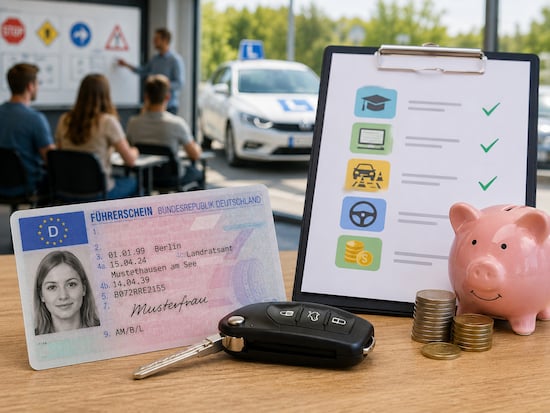
The exact document list depends on the individual case.
However, you will commonly need:
You need to prove your identity.
A registration certificate or other acceptable evidence may be required.
You should provide the actual licence rather than relying only on a copy.
A current biometric photograph is commonly required.
For certain non-EU/EEA licences, an official translation may be required.
Depending on the licence category, you may need medical certificates, eyesight documentation or other supporting documents.
The Federal Portal explicitly notes that additional documents depend on the driving licence category and issuing country.
No.
An International Driving Permit should not be confused with your underlying national driving licence.
For the German conversion procedure, the original foreign driving licence is important.
German regulations also tie an International Driving Permit to the underlying national driving licence.
If you are researching international permits, you can read our International Driving Licence article.
There is no single price for everyone.
The final cost depends on:
For example, Bavaria currently publishes approximate administrative fees of €38 for an EU/EEA/Annex 11 licence and €45 for a third-country licence, although individual cases can involve additional expenses.
Hamburg currently lists foreign driving licence conversion costs of approximately €37.50–€74.40, depending on the licence class and complete documentation.
These figures demonstrate why you should treat administrative fees separately from the total cost of obtaining the German licence.
If you want a broader overview, read our Driving Licence Cost Germany guide.
Sometimes.
If your licence qualifies for conversion without examinations, you may not need to complete the standard training programme associated with obtaining a German licence for the first time.
However, if you need to take a theory or practical examination, driving-school preparation can be extremely useful.
German roads may have different:
Even an experienced driver may benefit from learning the specific requirements used in Germany.
Read our Driving School Germany guide for more information.
Yes, in certain circumstances.
The answer depends on your issuing country and licence category.
Annex 11 specifically identifies licences for which theory and practical tests are waived.
However, you should not rely on general statements such as „all licences from country X are accepted without a test.“
The table can differentiate between licence categories.
Always check the current official requirements.
If your licence is from a country without a relevant simplified conversion arrangement, the process can be more demanding.
Depending on your circumstances, you may need to take:
You may also need to complete preparation with a driving school.
This does not necessarily mean that you have to start from the beginning as though you had never driven.
The exact requirements are determined by the applicable German regulations and your individual case.
This is an important issue.
A foreign driving licence cannot necessarily be converted simply because it was issued by a country that appears on a favourable list.
Authorities can consider whether the licence was genuinely acquired while you had the required residence in the issuing country.
For example, official German guidance states that for certain listed-country conversions, an applicant generally needs to have lived abroad for at least six months when obtaining the licence. A licence obtained during a short holiday is therefore not automatically eligible for conversion.
This is one reason why anyone considering obtaining a foreign licence shortly before moving to Germany should seek official advice first.
Another potentially complicated situation occurs when someone originally obtained a licence outside the EU and subsequently exchanged it for an EU driving licence in another country.
Having an EU-format driving licence does not necessarily resolve every recognition issue.
German law contains specific provisions concerning EU/EEA licences that originated from third-country licences.
If this applies to you, it is advisable to have your documents assessed by the competent German driving licence authority rather than assuming ordinary EU recognition applies.
If you have a non-EU/EEA licence, don’t assume you can use it indefinitely after moving to Germany.
Appointments, translations and examinations can take time.
Start early.
Some licences qualify for examination exemptions.
The opposite assumption can also be dangerous.
Always check the relevant country and category.
An International Driving Permit does not replace the underlying foreign licence.
Certain non-EU/EEA licences require an official translation.
Requirements can vary between categories such as B, C and D.
| Feature | EU/EEA Licence | Non-EU/EEA Licence |
|---|---|---|
| Recognition after moving to Germany | Generally recognised | Generally recognised for six months |
| Immediate exchange | Usually not required for harmonised categories | Generally required for continued driving after six months |
| Theory test | Generally not required for ordinary recognition | Depends on country/category |
| Practical test | Generally not required for ordinary recognition | Depends on country/category |
| Annex 11 | Usually not applicable | Important for eligible countries |
| Translation | Generally not required for EU licences | May be required |
| Local authority | Required when an exchange is necessary | Required for conversion |
| German licence | Depends on category/validity | Required for continued driving after recognition period |
The table is a general guide. Individual circumstances can change the applicable rules.
Before applying for a German licence, work through this checklist:

For a non-EU/EEA licence holder who establishes normal residence in Germany, the foreign licence is generally recognised for six months.
Generally yes, provided the licence is valid and covers the relevant category. EU/EEA licences for harmonised categories generally do not require immediate conversion.
If you establish normal residence in Germany and want to continue driving after the six-month recognition period, you generally need to obtain a German licence through the applicable conversion process.
Not always. Some foreign licences are subject to special exemptions under Annex 11.
Administrative fees vary by authority and circumstances. Additional costs may include translation, examinations, driving lessons and medical requirements.
Some non-EU/EEA licence holders do. The exact requirement depends on the issuing country, licence and applicable authority.
Not necessarily. German authorities can impose residence-related conditions for conversion, and a licence obtained during a short holiday may not qualify.
You normally apply to the Fahrerlaubnisbehörde responsible for your place of residence.
Understanding the rules surrounding a foreign driving licence Germany is essential if you plan to live in the country for an extended period.
The most important factors are:
For many non-EU/EEA licence holders, the six-month period is particularly important. Once normal residence has been established, the foreign licence is generally recognised for six months, after which a German licence is required to continue driving.
At the same time, the process can be significantly easier for certain countries and licence categories because Germany provides examination exemptions under Annex 11.
The safest approach is to begin the process early, gather the correct documentation and confirm your individual circumstances with the responsible Fahrerlaubnisbehörde.
For more information about German driving licences, licence conversion, driving tests, costs and requirements, explore the guides available at FahrenExperten.
Driving Licence in Germany: Everything You Need to Know A driving licence is an important...
Weiterlesen
Rijbewijs kosten in Duitsland: een compleet overzicht Wie in Duitsland zijn rijbewijs wil halen, vraagt...
Weiterlesen