Driving Licence in Germany: Everything You Need to Know A driving licence is an important...
Weiterlesen


Driving Licence in Germany: Everything You Need to Know A driving licence is an important...
Weiterlesen
Rijbewijs kosten in Duitsland: een compleet overzicht Wie in Duitsland zijn rijbewijs wil halen, vraagt...
WeiterlesenIf you have moved to Germany and already hold a valid driving licence from another country, you may be wondering how to convert foreign driving licence Germany and whether you need to take German driving tests.
The answer depends primarily on where your driving licence was issued.
Germany treats driving licences issued in the EU/EEA differently from licences issued by countries outside the EU/EEA. For many EU/EEA licences, conversion is not immediately required. By contrast, holders of most non-EU/EEA licences who establish normal residence in Germany can generally use their foreign licence for only six months before needing to obtain a German licence through the applicable conversion procedure.
The exact requirements can also depend on the country that issued your licence. Certain non-EU/EEA countries are listed in Annex 11 of the German Driving Licence Regulation (FeV) and may benefit from simplified conversion rules, including exemption from one or both examinations.
This guide explains the process in detail so you can understand how to convert a foreign driving licence in Germany, what documents you may need, when examinations are required and what mistakes to avoid.
For more German driving licence information, visit FahrenExperten.
Yes, in many circumstances.
However, „convert“ or „exchange“ does not mean exactly the same thing for every foreign licence holder.
Your situation generally falls into one of these categories:
Understanding which category applies to you is the first step.
If your driving licence was issued by an EU or EEA country, the rules are generally more straightforward.
EU/EEA countries include the EU Member States plus Iceland, Liechtenstein and Norway.
For harmonised driving licence categories, including categories such as A and B, a valid EU/EEA licence generally does not need to be immediately exchanged simply because you move to Germany.
In many cases, you can continue using the licence in Germany.
Conversion can become necessary when the licence or a particular category reaches its applicable expiry or renewal point.
There are also special rules for certain professional categories, particularly heavy vehicle and bus licences.
If you have an EU licence, read our EU Driving Licence Germany guide for additional information.
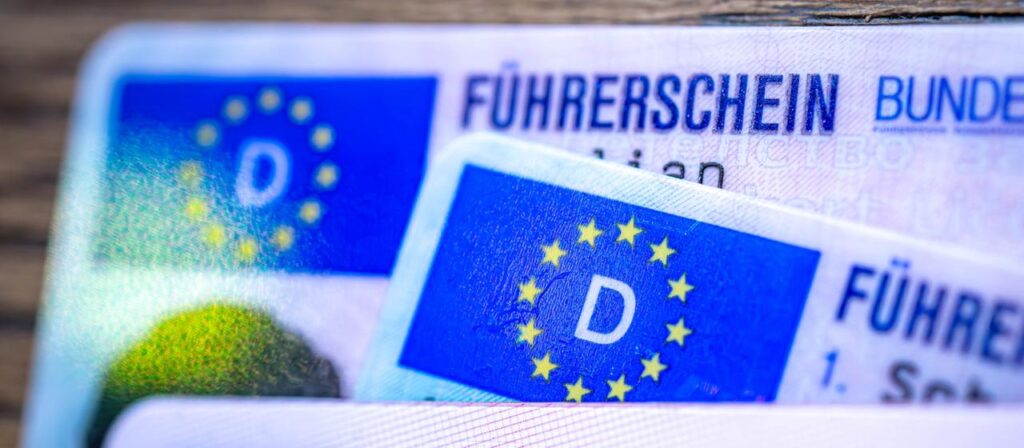
If your licence was issued outside the EU/EEA, the process is different.
Under German rules, once you establish your normal residence in Germany, a foreign non-EU/EEA driving licence generally remains usable for six months. After this period, you need a German driving licence to continue driving in Germany.
The six-month period is therefore one of the most important deadlines for anyone searching for information about convert foreign driving licence Germany.
For example:
You establish normal residence in Germany → Your foreign licence is recognised for the applicable six-month period → You apply for conversion → You complete any required examinations → You receive your German licence.
Do not wait until the final weeks if your conversion requires examinations.
The six-month rule is connected to establishing your normal residence in Germany.
The Federal Portal explains this in terms of living in Germany for at least 185 days per year for personal and/or professional reasons.
This is important because simply visiting Germany temporarily is not necessarily the same as establishing normal residence.
Certain categories of people, such as commuters and students, can be subject to specific rules.
If your circumstances are unusual, contact the competent German driving licence authority before relying on the standard six-month rule.
This is one of the most important questions when you want to convert foreign driving licence Germany.
The answer depends on your country of licence issue.
For many non-EU/EEA licences, German authorities require both:
However, countries listed in Annex 11 FeV may have simplified requirements. Depending on the country and licence category, you may need:
The German Federal Portal specifically identifies Annex 11 countries as an exception to the general requirement for both tests.
Therefore, never assume that every foreign licence requires a complete German driving course.
Annex 11 of the Fahrerlaubnis-Verordnung (FeV) contains country-specific provisions concerning the exchange of certain foreign driving licences.
This can significantly simplify the process for eligible licence holders.
The current Federal Portal lists countries and territories including, among others:
The exact examination requirements still depend on the relevant country and licence category, so the list alone does not mean that every licence from one of these countries receives identical treatment.
This is why checking the applicable Annex 11 provision is essential.
The exact documentation can vary according to the local authority and your individual circumstances.
Commonly requested documents include:
The Federal Portal notes that for non-EU licences, the original foreign licence and, where applicable, a German translation are required; an international driving permit by itself is not sufficient for the conversion procedure.
Before submitting your application, check the exact document requirements with your local Fahrerlaubnisbehörde.
No.
An International Driving Permit (IDP) is not a replacement for your original foreign driving licence.
The German Federal Portal explicitly states that an international driving licence/permit is not sufficient for the conversion application.
You should therefore keep your original foreign licence available and check whether you need an official translation.
For more information, read our International Driving Licence guide.
First determine:
This determines which conversion rules may apply.
Establish when your normal residence in Germany began.
For many non-EU/EEA licence holders, the relevant period is six months after establishing normal residence.
Keeping track of this date is essential.
Applications are normally handled by the competent Fahrerlaubnisbehörde in your area.
The authority checks your documents and determines the applicable conversion requirements.
Collect the required documentation before your appointment.
Depending on your case, this may include your passport, registration documentation, photograph, original driving licence, translation and evidence relating to health or first aid.
Submit your conversion application to the responsible authority.
The authority will review the foreign licence and determine whether examinations are required.
If your licence requires theory and/or practical examinations, a German driving school can help you prepare.
For non-EU/EEA licence holders who need examinations, driving-school preparation can be particularly useful even where the law does not require you to complete the entire first-time learner training process.
Explore our Driving School Germany guide.
If your country does not qualify for an examination exemption, you may need to pass:
The applicable Annex 11 provisions determine whether one or both are required.
Read our German Theory Test guide before beginning your preparation.
Once all requirements have been satisfied, the authority can issue your German driving licence.
The foreign licence may be retained by the German authority and returned to the issuing country or otherwise handled according to the applicable procedure.

The cost depends on your circumstances.
Possible expenses include:
For example, official government portals currently show conversion fees in different ranges depending on the type of application and local circumstances. One Federal Portal service lists approximately €37.50–€74.60 for certain EU/EEA-related conversion procedures, while fees for non-EU/EEA conversions depend on the applicable procedure.
The driving-school and examination preparation costs can be much more significant if you are required to take tests.
For a broader overview, see our Driving Licence Cost Germany guide.
Sometimes.
This depends on the country where your licence was issued.
EU/EEA licence holders generally have significantly simpler recognition rules for harmonised categories.
For non-EU/EEA licences, Annex 11 may provide an exemption from one or both examinations depending on the issuing country and category.
Therefore, the phrase „convert foreign driving licence Germany without test„ should not be interpreted as a universal rule.
The correct approach is:
Check your issuing country → Check Annex 11 → Check your licence category → Confirm with your local authority.
Potentially, but it depends on your examination requirements.
If your foreign licence qualifies for conversion without examinations, you may not need to undertake a conventional German learner-driver programme.
If you must take a theory or practical examination, however, professional preparation can be extremely valuable.
For a practical examination, you need to demonstrate that you can drive safely under German traffic conditions.
See our German Driving Exam guide for more information.
If you hold a non-EU/EEA licence and establish normal residence in Germany, the standard recognition period is generally six months. After that, you cannot simply continue driving indefinitely on the foreign licence.
This can have serious consequences.
Therefore, if your six-month period is approaching its end, contact your local driving licence authority immediately.
In some circumstances, authorities may be able to extend the period where you can demonstrate that your normal residence in Germany will not exceed twelve months. The exact requirements are case-specific.
Do not assume an extension will automatically be granted.
This is an important special case.
Simply having an EU-format driving licence does not necessarily mean that the underlying licence history is irrelevant.
German authorities pay attention to situations where a third-country licence was converted into an EU/EEA licence without the required driving examinations.
The Federal Portal warns that certain EU/EEA licences based on third-country licences may not be recognised in Germany in the same way as an ordinary EU/EEA licence.
If your EU licence contains information indicating that it was exchanged from a third-country licence, such as code 70 with the original country code, seek advice from the competent German authority before driving on it.
It isn’t.
EU/EEA and non-EU/EEA licences are subject to different rules.
Conversion procedures and examinations can take time.
Start researching early.
It does not.
Your original foreign licence remains important.
Some foreign licence holders may qualify for simplified conversion procedures.
Check your country’s rules before paying for a complete learner-driver programme.
An EU-format document does not automatically resolve every issue if the licence was originally issued outside the EU/EEA.
Even if you have been driving for years, German road rules may differ from those in your home country.
If you need an examination, study German traffic regulations carefully.
If you hold an EU/EEA licence, the process is generally straightforward.
For harmonised categories, a valid EU/EEA licence normally remains recognised in Germany without immediate conversion.
However, conversion may become necessary when:
For example, categories C and D can be subject to German validity periods even where the foreign document shows a longer or no expiry period.
If you hold a licence from outside the EU/EEA, start the process as early as possible.
Your checklist should be:
✓ Check your six-month period
✓ Identify whether your country is listed in Annex 11
✓ Determine whether theory and/or practical tests are required
✓ Contact your local Fahrerlaubnisbehörde
✓ Prepare your documents
✓ Arrange translation if necessary
✓ Find a suitable driving school if examinations are required
✓ Complete the required tests
✓ Apply for your German licence
This approach can help prevent unnecessary delays.
For most non-EU/EEA licence holders who establish normal residence in Germany, the foreign licence is generally recognised for six months.
Generally, no. If you have established normal residence in Germany, you normally need a German licence after the applicable six-month period.
Not generally for harmonised categories simply because you move to Germany. Conversion is generally required when the licence or category reaches the applicable renewal/expiry point.
It depends on the issuing country and licence category. Annex 11 provides exemptions or reduced examination requirements for certain countries.
In some cases, yes. The exact answer depends on the issuing country and applicable Annex 11 provision.
No. An international driving permit is not sufficient by itself for the conversion procedure.
Costs vary according to the type of licence and procedure. You may have to pay administrative fees, translation costs, examination fees and driving-school costs if tests are required.
You normally apply to the Fahrerlaubnisbehörde responsible for your place of residence.
If you want to convert foreign driving licence Germany, the most important thing is to determine which rules apply to your specific licence.
An EU/EEA licence is generally treated differently from a licence issued outside the EU/EEA. For non-EU/EEA licences, the six-month recognition period after establishing normal residence is particularly important.
The country of issue can also make a major difference. If your licence comes from an Annex 11 country, you may benefit from a simplified conversion process and may not have to take both German driving examinations.
The safest strategy is to start early, identify your applicable category, gather your documents and confirm the requirements with the responsible German driving licence authority.
For more information about foreign licences, German driving tests, costs and licence requirements, explore FahrenExperten.
Driving Licence in Germany: Everything You Need to Know A driving licence is an important...
Weiterlesen
Rijbewijs kosten in Duitsland: een compleet overzicht Wie in Duitsland zijn rijbewijs wil halen, vraagt...
Weiterlesen