Driving Licence in Germany: Everything You Need to Know A driving licence is an important...
Weiterlesen

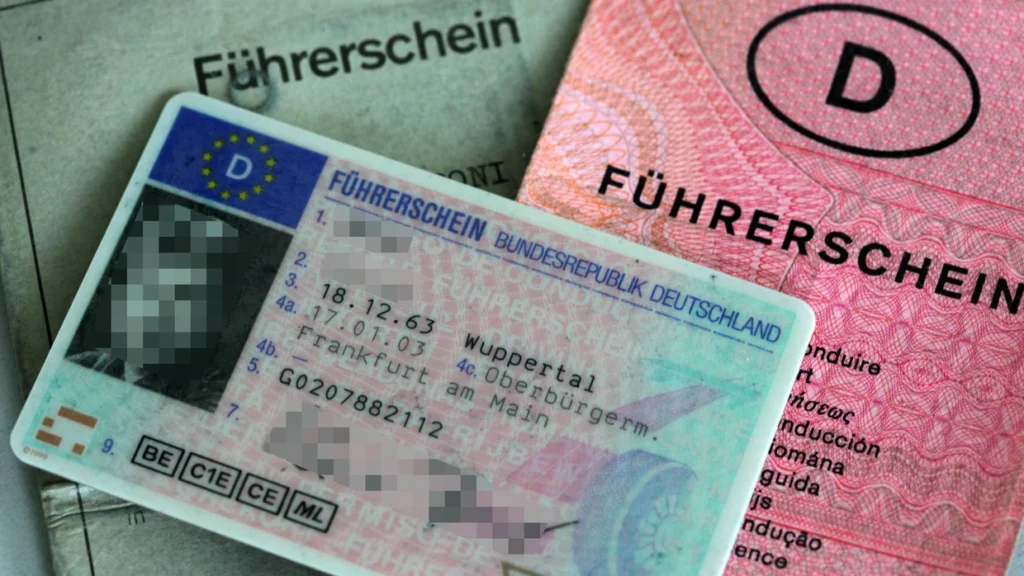

Driving Licence in Germany: Everything You Need to Know A driving licence is an important...
Weiterlesen
Rijbewijs kosten in Duitsland: een compleet overzicht Wie in Duitsland zijn rijbewijs wil halen, vraagt...
WeiterlesenIf you are planning to live, work or study in Germany, learning how to get a driving licence in Germany can be an important step toward greater independence and mobility.
Germany has a structured driving-licence system that combines administrative requirements, driver training, theoretical knowledge and practical driving skills. Whether you are a German citizen, an EU citizen, an expatriate or an international resident, understanding the process before you begin can help you avoid unnecessary delays and expenses.
For a first German driving licence, applicants generally need to have their ordinary residence in Germany, satisfy the applicable age and fitness requirements, complete the required training and pass the theory and practical examinations. Germany’s Federal Ministry of Transport states that ordinary residence generally means living in Germany for at least 185 days per year.
In this guide, we explain how to get a driving licence in Germany step by step.
For additional information about German and European driving licences, visit FahrenExperten.

A German driving licence is an official document confirming that its holder is authorised to drive specific categories of motor vehicles.
Germany uses the European Union’s harmonised driving-licence categories, including:
For most people interested in learning how to drive a car, Category B is the relevant licence.
Germany’s Federal Ministry of Transport currently lists Category B as having a standard minimum age of 18, with a possibility of obtaining it from 17 under the applicable accompanied-driving arrangement.
Before starting the application process, you need to meet Germany’s basic eligibility requirements.
Generally, you need to:
The European Union also requires applicants for an EU driving licence to normally reside in the country where they apply. The standard rule is generally based on living there for at least 185 days per calendar year.
If you are specifically interested in the legal concept of Fahrerlaubnis, see the driving-licence information available through FahrenExperten.
One of the first things to consider when learning how to get a driving licence in Germany is your residence.
You generally cannot simply choose Germany as a convenient place to obtain an EU driving licence if you normally live somewhere else.
German authorities state that applicants must have their ordinary residence in Germany, generally meaning that they live there for at least 185 days per year.
EU rules use a similar ordinary-residence principle.
This requirement is particularly important for:
If you are moving from another EU country, read our resources about the EU driver’s license and European driving licence through FahrenExperten.
Before enrolling in a driving school, determine which licence category you need.
For ordinary passenger cars, Category B is the most common choice.
Other categories apply to motorcycles, trucks, buses and vehicles with trailers.
| Category | General vehicle type |
|---|---|
| AM | Mopeds and light vehicles |
| A1 | Light motorcycles |
| A2 | Medium motorcycles |
| A | Motorcycles |
| B | Cars and certain light vehicles |
| BE | Cars with certain trailers |
| C1 | Medium goods vehicles |
| C | Heavy goods vehicles |
| D1 | Certain smaller buses |
| D | Buses |
The precise requirements and minimum ages depend on the category.
The EU framework provides minimum-age rules while allowing Member States some flexibility for particular categories.
For a car licence, our Führerschein Klasse B resources at FahrenExperten can provide additional guidance.
The next major step is choosing a Fahrschule, or driving school.
Your driving school will normally help you prepare for both the theory and practical examinations.
When comparing driving schools, consider:
Do not choose a driving school based solely on the cheapest advertised lesson price.
The total cost of obtaining a driving licence depends heavily on the number of practical lessons you need.
For more information about choosing a driving school in Germany, visit FahrenExperten.
For a first German driving licence, applicants generally need to complete the required first-aid training and provide the necessary documentation as part of the application process.
A first-aid course is designed to teach drivers what to do in the event of a road accident or other emergency.
Topics commonly include:
Make sure your course satisfies the requirements applicable to your licence application.
An eyesight test is another important part of the process.
The purpose is to establish whether your vision meets the requirements for safe driving.
If the eyesight test identifies a problem, you may need additional examination or corrective lenses.
If you normally wear glasses or contact lenses, make sure you follow the relevant requirements during driving and testing.
When applying for a German driving licence, you will need various documents.
Depending on your individual circumstances and licence category, these can include:
Your local Fahrerlaubnisbehörde can tell you exactly which documents are required for your particular application.
It is advisable to confirm the requirements before submitting your application.
After preparing your documents, you submit your application to the competent driving-licence authority.
The exact procedure can vary between municipalities and administrative districts.
Your application is then processed by the relevant authority.
This step is important because you should not assume that simply registering with a driving school automatically means your licence application has been completed.
Your driving school can usually explain how the process works locally, but the licensing authority is responsible for the official application.
One of the most important parts of learning how to get a driving licence in Germany is preparing for the theoretical examination.
German driver training covers areas such as:
The Federal Ministry of Transport explains that the theoretical examination tests knowledge of relevant legal regulations, environmentally conscious and energy-efficient driving, road-traffic hazards and fundamental technical relationships important to road safety.
Do not rely only on memorising answers.
Understanding why an answer is correct will help you both in the examination and on the road.
For additional theory-learning resources, visit FahrenExperten.
The German theory examination uses questions presented in different formats.
The official question catalogue is developed and continuously updated through the relevant German authorities and testing organisations.
To prepare effectively:
Short, regular sessions are usually more effective than trying to learn everything immediately before the examination.
Practice questions help you become familiar with the structure and logic of the examination.
Pay particular attention to:
Keep a list of questions you repeatedly answer incorrectly.
Once your training and application requirements have been satisfied, you can take the theoretical examination.
In Germany, driving examinations are conducted by authorised testing organisations, including TÜV and DEKRA testing centres.
The theory examination tests whether you have sufficient knowledge to operate a motor vehicle safely and responsibly.
Passing the theory examination is an important milestone, but it does not mean you can drive independently.
You still need to complete the practical training and pass the practical examination.
The practical part of the process is where you develop actual driving skills.
Your instructor will teach you how to:
The goal is not simply to make the car move.
You need to demonstrate that you can make safe, independent decisions in different traffic situations.
For Category B training, certain mandatory special training drives form part of the practical instruction.
These include driving experiences on different types of roads and under specific conditions.
The purpose is to prepare the learner for situations that may not occur frequently during ordinary urban driving.
Your driving instructor will determine when you are ready for these parts of the training.
The practical examination is the final major hurdle before receiving your German driving licence.
The Federal Ministry of Transport explains that driving-licence applicants generally demonstrate their competence through both a theoretical and a practical examination.
During practical training, focus on:
Regularly check mirrors and understand what is happening around your vehicle.
Drive at an appropriate speed rather than simply driving at the posted maximum.
Maintain the correct position within your lane and around intersections.
Recognise and respond correctly to signs, markings and traffic situations.
Practise different parking techniques until they become routine.
Anticipate pedestrians, cyclists, motorcycles and other road users.
Develop the ability to follow directions and make safe decisions without constant instructor intervention.
The practical examination evaluates your ability to drive safely and demonstrate the necessary skills.
Your examiner may assess areas including:
The purpose is to determine whether you have the competence required to drive safely.
Passing the practical test is the final major step toward obtaining your driving licence.
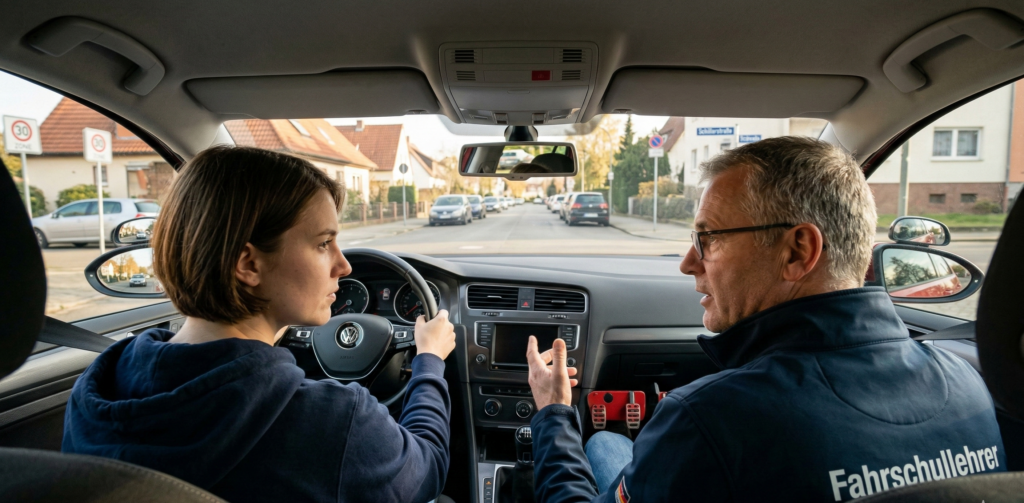
Once you successfully pass the practical examination, the licence can be issued according to the applicable procedure.
For many new drivers, this represents the beginning rather than the end of their driving education.
New drivers should continue developing:
Confidence should come from experience and good driving habits, not excessive speed or risk-taking.
There is no single fixed timeframe for everyone.
The process can depend on:
Someone who takes frequent lessons and progresses quickly may complete the process faster than someone who takes lessons only occasionally.
Therefore, it is better to plan the process around your training needs rather than a fixed number of weeks.
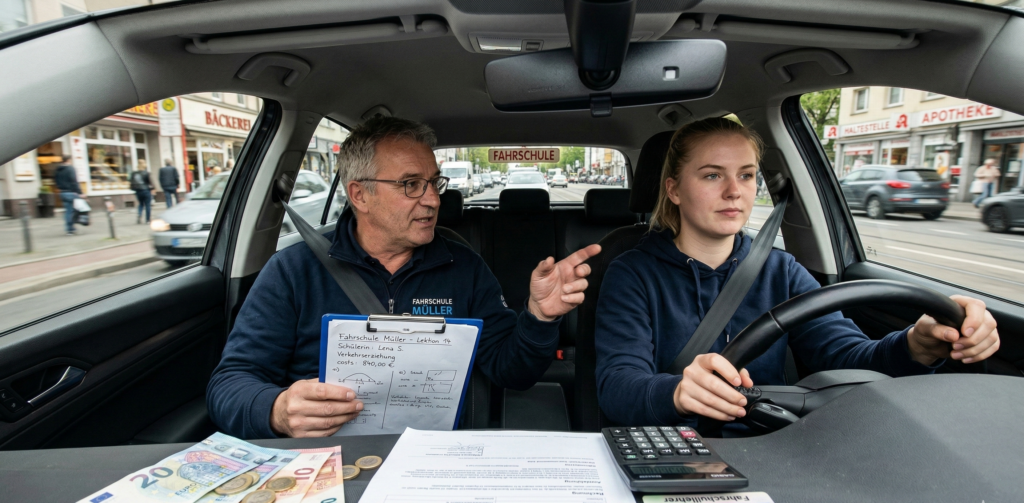
The cost of obtaining a German driving licence varies considerably.
Your total expenditure can include:
The largest variable is usually the amount of practical driving instruction required.
For a detailed discussion of German licence costs, visit the Führerschein Kosten resources at FahrenExperten.
Yes. Foreign nationals who meet the applicable German requirements can obtain a German driving licence.
However, residence requirements are important.
If you are an international resident who normally lives in Germany, you may be able to apply for a German licence if you satisfy the relevant conditions.
The EU’s general rule is that applicants normally obtain a driving licence in the country where they have their normal residence.
If you already have a foreign driving licence, however, you may not need to start from the beginning.
Your existing licence may be recognised or may qualify for an exchange depending on where it was issued and your circumstances.
Read our information on foreign driving licences in Germany at FahrenExperten.
This depends on the country that issued your licence.
EU/EEA driving licences are generally treated differently from licences issued by countries outside the EU/EEA.
For non-EU/EEA licences, German rules determine whether an exchange is possible and whether theory or practical testing is required.
Consequently, someone with an existing foreign licence should investigate Führerschein Umschreiben before enrolling in a complete beginner driving course.
This can potentially save considerable time and money, depending on the individual circumstances.
For more information, visit FahrenExperten.
EU citizens can benefit from the European system of mutual recognition of driving licences.
If you already hold a valid EU driving licence, you generally do not need to obtain a completely new German licence simply because you move to Germany.
The German Federal Ministry of Transport confirms that valid EU/EEA driving licences normally remain valid in Germany until their expiry.
If you do not have a driving licence and want to obtain your first licence in Germany, however, you still need to satisfy Germany’s licensing requirements.
Non-EU residents can also obtain a German driving licence if they meet the applicable requirements.
The key issues include:
If you already have a licence from your home country, investigate whether it can be recognised or exchanged before starting a full German training programme.
A valid German driving licence is an EU driving licence.
EU driving licences are generally recognised across the European Union. The European Commission states that a valid licence issued in an EU country can generally be used throughout the EU.
However, drivers must still follow the traffic regulations of the country they are visiting.
For example, speed limits, alcohol limits, vehicle equipment requirements and other road rules can differ between countries.
For broader information about European driving licences, visit FahrenExperten.
For someone obtaining a first German driving licence, professional driving-school training is an integral part of the process.
Germany has structured driver training requirements, and the practical component must be completed through the appropriate training process before taking the examination.
The European Union establishes minimum standards for driving tests but does not create a single EU-wide system for driving schools or driver training.
This is why the exact training structure can differ between EU countries.
If your goal is to successfully obtain a German driving licence, preparation is essential.
Most importantly, learn to drive safely rather than simply drive for the test.
Low lesson prices do not necessarily mean low total costs.
Some learners require considerably more lessons than others.
Understanding traffic principles is much more useful than memorisation alone.
Missing documentation can delay your application.
You may qualify for an exchange or recognition procedure.
Testing availability can affect your overall timeline.
Real-world driving requires continuous learning and awareness.
Generally, you need to establish ordinary residence in Germany, meet the age and fitness requirements, apply for the licence, complete the required training, pass the theory test and pass the practical driving test.
The standard minimum age for Category B is 18. Germany also has an accompanied-driving route from age 17 under applicable conditions.
Yes, provided they meet the applicable German requirements and residence conditions.
Generally, yes. Applicants must normally have their ordinary residence in Germany. German authorities describe this, in simplified terms, as living in Germany for at least 185 days per year.
For a standard first licence, applicants generally need to demonstrate competence through theoretical and practical examinations.
There is no fixed duration. It depends on your application, driving-school schedule, lesson frequency, examination availability and individual progress.
There is no universal fixed price. The final amount depends heavily on the driving school, number of lessons, examination fees, administrative costs and whether you need to repeat an examination.
Generally yes. Valid EU/EEA driving licences normally remain valid in Germany until their expiry.
Potentially. The procedure depends heavily on the country that issued the foreign licence and your individual circumstances.
Generally yes. A valid German licence is an EU driving licence and is generally recognised throughout the EU.
Understanding how to get a driving licence in Germany before you start can make the entire process much easier.
For a first licence, the process generally involves establishing the required residence, choosing the correct licence category, selecting a driving school, completing the necessary administrative and training requirements, studying for the theory examination, completing practical driving lessons and passing both examinations.
For international residents, there is an additional question that should always be answered first:
Do you actually need to obtain a new German driving licence?
If you already have a driving licence from another country, you may be eligible for recognition or exchange instead of going through the complete beginner process.
The rules can also differ depending on whether your licence was issued in an EU/EEA country or outside the EU/EEA.
Germany’s Federal Ministry of Transport confirms that ordinary residence is an important prerequisite for obtaining a German licence, while EU rules similarly use the 185-day normal-residence principle.
For the latest information about German driving licences, EU driving licences, foreign licences, driving tests and licence exchanges, visit FahrenExperten.
Driving Licence in Germany: Everything You Need to Know A driving licence is an important...
Weiterlesen
Rijbewijs kosten in Duitsland: een compleet overzicht Wie in Duitsland zijn rijbewijs wil halen, vraagt...
Weiterlesen