Driving Licence in Germany: Everything You Need to Know A driving licence is an important...
Weiterlesen


Driving Licence in Germany: Everything You Need to Know A driving licence is an important...
Weiterlesen
Rijbewijs kosten in Duitsland: een compleet overzicht Wie in Duitsland zijn rijbewijs wil halen, vraagt...
WeiterlesenAn EU driver’s license is one of the most important documents for anyone who wants to drive, travel, work or live across Europe. Thanks to European rules on driving-licence recognition, a valid driving licence issued by one EU country can generally be used in other EU countries without requiring you to obtain a completely new licence.
For travellers, expatriates, students and professionals who regularly cross European borders, understanding how an EU driver’s license works can make international driving much easier.
However, EU driving-licence rules contain important details concerning validity, residence, licence exchanges, age requirements, provisional licences and licences originally issued outside the European Union.
This guide explains everything you should know about the EU driver’s license, including how it works in Germany, whether you can use it in another European country, when an exchange is necessary, and how an EU licence differs from an International Driving Permit.
For more information about driving licences in Germany and Europe, visit FahrenExperten.

An EU driver’s license, also called an EU driving licence or European driving licence, is a national driving licence issued by an EU Member State under the European Union’s driving-licence framework.
Each EU country is responsible for issuing its own driving licences. However, common European rules help ensure that valid licences are recognised throughout the EU.
The European Commission states that if your driving licence was issued in an EU country, you can generally use it anywhere in the EU.
The EU introduced a standard driving-licence format in 2013. Modern licences are generally plastic, credit-card-sized documents containing security features and standardised information.
This system makes it considerably easier for European drivers to travel across borders.
Yes. One of the major advantages of an EU driver’s license is mutual recognition.
The European Commission confirms that valid driving licences issued in EU Member States can generally be used throughout the EU.
For example, a valid driving licence issued in:
can generally be used when driving in another EU country.
The European Commission also states that valid driving licences in use throughout the European Economic Area are mutually recognised.
However, recognition does not mean that every driving rule is identical across Europe. National traffic laws, minimum ages and certain restrictions can still differ.
The expressions EU driver’s license and European driver’s license are often used to describe the same general concept.
There is, however, an important distinction between a European national driving licence and an International Driving Permit.
| Document | Purpose |
|---|---|
| EU driver’s license | National driving licence issued by an EU country |
| European driving licence | Common term for an EU/EEA national licence |
| International Driving Permit | Supplementary document for international driving |
| Foreign driving licence | Licence issued by another country |
An EU driver’s license is your actual driving entitlement.
An International Driving Permit does not replace it.
For information about international driving documentation, read our International Driving Permit guide.
Germany recognises valid driving licences issued by EU Member States and EEA countries.
The German Federal Ministry of Transport states that an EU or EEA driving licence normally remains valid in Germany until the end of its validity period, including when the holder establishes residence in Germany.
This means that someone moving from France, Spain, Italy, Austria or another EU/EEA country to Germany generally does not need to immediately exchange their driving licence for a German one.
However, there are circumstances in which an exchange or renewal can become necessary.
For more information, visit our German Driver’s License guide.
Yes.
If you have a valid EU driver’s license, you can generally drive in Germany without obtaining a German driving licence simply because you are visiting or have moved there.
The German Federal Ministry of Transport confirms that an EU/EEA licence normally remains valid in Germany until its expiry date.
You should nevertheless comply with German traffic laws, including:
Having an EU driver’s license does not exempt you from German road regulations.
One important concept in European driving-licence law is normal residence.
As a general rule, you should obtain your EU driver’s license in the country where you normally live.
The European Commission explains that applicants generally need to apply in the EU country where they have their normal residence. This is generally the country where they live for at least 185 days per calendar year because of personal or work-related ties.
This rule is important because an EU driving licence should not simply be obtained in whichever country appears to have the easiest licensing process.
For example, someone who normally lives in Germany generally cannot simply travel to another EU country solely to obtain a driving licence there without satisfying the applicable residence requirements.
Although each EU country has its own administrative procedures, European rules establish minimum standards for driving tests and certain licence requirements.
Generally, you must:
The European Commission states that an applicant must generally be normally resident in the EU country where they apply, meet minimum age and medical requirements, and pass a driving test.
For detailed information about examinations, read our Driving Test resources.
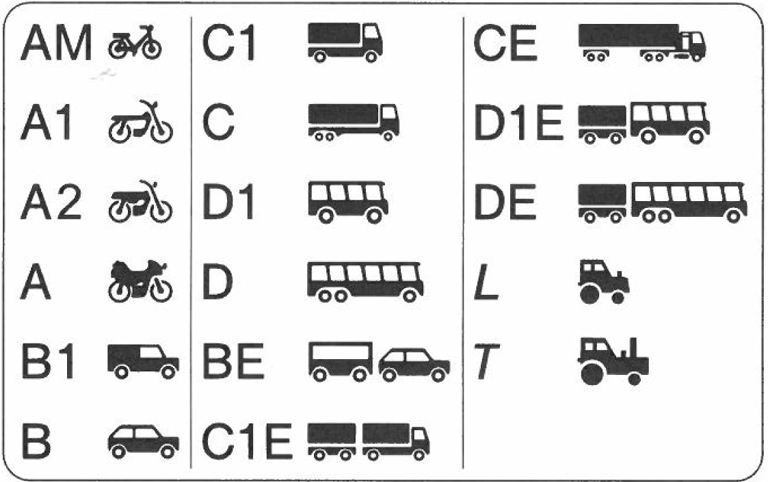
The EU driving-licence system covers a range of vehicle categories.
These include:
The European Commission lists these categories among the driving-licence categories recognised throughout Europe.
For drivers interested specifically in cars, see our Führerschein Klasse B guide.
Category B is one of the most commonly held EU driving-licence categories.
It generally covers ordinary passenger cars and certain light vehicles, subject to the specific rules applicable to the licence.
If you hold a valid Category B EU driver’s license, you can generally use it when driving in other EU countries.
However, age restrictions can differ.
The European Commission provides an example showing that the minimum age for driving certain vehicle categories can differ between EU countries.
Therefore, if a young driver intends to drive abroad, it is important to verify the rules of the destination country.
The minimum driving age depends on the vehicle category and national rules.
EU rules establish certain framework requirements, but individual countries can have different minimum ages for specific categories.
This is particularly important for:
A licence that is valid in the country where it was issued does not necessarily mean that every driver can use the same category at the same age in every other EU country.
Before travelling, check the rules of the destination country.
The validity of an EU driver’s license depends on the licence category and national rules.
Standard EU licences use harmonised formats, but validity periods can vary depending on the category and issuing country.
The European Commission also notes that if your licence expires while you are abroad, it becomes invalid and may not be recognised in another country.
Therefore, check the expiry date before travelling.
For more information, visit our Führerschein Gültigkeit guide.
If you move to another EU country and your licence expires, you generally renew it in the country where you have your normal residence.
The European Commission confirms that when an EU resident’s driving licence expires, it must generally be renewed in the country of normal residence.
The new licence will be issued in the standard EU format and may have a different validity period based on the rules of the country where it is renewed.
Read our Führerschein Verlängern guide for related information.
Usually, no.
If you move from one EU country to another, you generally do not have to exchange your EU driver’s license immediately.
The European Commission explains that you can generally keep your existing EU licence when moving to another EU country.
However, an exchange may become mandatory in certain circumstances, including:
Suppose you have a French EU driver’s license and move permanently to Germany.
You generally do not have to immediately exchange it for a German licence.
The German Federal Ministry of Transport confirms that EU/EEA licences normally remain valid in Germany until their expiry.
If your licence expires while Germany is your country of normal residence, you may need to renew it through the German authorities.
This is different from having a driving licence issued outside the EU/EEA.
For information about licence exchanges, see our Führerschein Umschreiben Deutschland guide.
This is an area where drivers need to be particularly careful.
Suppose you originally obtained a driving licence outside the EU and later exchanged it for an EU driving licence.
That EU licence may not automatically receive exactly the same recognition in another EU country as a licence originally obtained through the normal EU licensing process.
The European Commission specifically warns that if an EU driving licence was issued in exchange for a non-EU licence, recognition can become more complicated when moving to another EU country.
For example, a person might:
Non-EU licence → exchanged for Spanish licence → moves to Germany
The Spanish licence is an EU driving licence, but German authorities may need to consider how the original non-EU licence was obtained and exchanged.
Therefore, always check the rules before moving.
This is one of the most important situations to understand.
An EU driving licence issued after exchanging a non-EU licence may be valid in the issuing EU country but can present additional recognition questions when its holder moves to another EU country.
The European Commission provides guidance specifically warning about EU licences issued in exchange for non-EU licences.
If this applies to you, keep documentation relating to:
This information can be important when dealing with another EU authority.
An EU driver’s license should not be confused with an International Driving Permit.
If you have a valid EU licence, you generally do not need an IDP simply to drive in another EU country.
The European Commission notes that International Driving Permits are not regulated at EU level and may not be recognised in another EU country.
For driving outside Europe, however, an IDP may be required depending on the destination.
Read our International Driving Licence guide for more information.
An EU driver’s license is generally suitable for renting a vehicle within the EU, provided you satisfy the rental company’s requirements.
However, rental companies can impose additional conditions.
Before booking a car, check:
Having a valid EU driver’s license does not guarantee that a rental company will accept every driver under every circumstance.
One of the greatest benefits of an EU driver’s license is the ability to travel by car across European borders.
You can use a valid EU licence when driving in other EU countries, but you remain subject to local road rules.
For example, countries can have different:
The European Union does not have completely identical traffic regulations across all Member States.
Therefore, licence recognition and traffic-law harmonisation are two different things.
A valid EU driver’s license is only one part of your international driving documentation.
You should also make sure that your car insurance is valid in every country you intend to visit.
The European Commission recommends checking both driving-licence and insurance validity before travelling by car within the EU.
If you are using a rental vehicle, confirm exactly what insurance is included in your rental agreement.
For people living and working in Europe, an EU driver’s license can be particularly valuable.
If you relocate between EU countries, the mutual recognition framework can make it much easier to continue driving without taking a completely new driving test.
However, residence rules remain important.
If you move to another EU country, your normal residence determines where certain licensing procedures, including renewal, must take place.
Expats should therefore keep track of:
Students can have special circumstances under European driving-licence rules.
Studying temporarily in another EU country does not necessarily mean that your normal residence has changed.
The European Commission explains that students may in certain circumstances obtain a driving licence in their host country if they can prove they have been studying there for at least six months.
Students should therefore examine their individual residence situation before applying for a licence.
No.
The European Commission states that you can have only one EU driving licence at any one time.
This rule helps prevent drivers from maintaining multiple EU licences from different countries.
When an EU country exchanges your licence, the authorities generally verify information with the authorities of your previous country of residence.
If your EU driver’s license is lost or stolen, contact the relevant authorities.
The procedure depends on where you are when the loss occurs.
If you are travelling, contact:
Do not assume that a photograph or photocopy of your licence automatically serves as a legal replacement.
For related information, read our Führerschein Verloren guide.
A provisional or temporary driving document should not automatically be treated in the same way as a full EU driver’s license.
The European Commission warns that provisional and temporary licences are not regulated at EU level in the same way as standard licences and may not be recognised in another EU country.
If you have only a temporary document, check with the relevant authorities before driving abroad.
Not every EU driving licence is necessarily the newest plastic card.
Older EU-issued licences can remain valid under certain conditions.
The European Commission states that old-style EU driving licences can still be used in EU countries and will generally be replaced with the standard format when renewed, with the old formats subject to an exchange deadline no later than 2033.
Therefore, an older-looking licence is not automatically invalid.
EU driving-licence legislation is evolving.
Modernised EU rules entered into force in November 2025, introducing measures intended to improve road safety and harmonise certain aspects of licensing across Europe.
The updated framework includes developments such as:
The new EU framework also provides for an EU mobile driving licence to be introduced and mutually recognised by the end of 2030 at the latest.
Because implementation takes place over time, drivers should distinguish between rules already applicable and measures that still require national implementation.
Mutual recognition does not mean that a driver can avoid the consequences of serious offences simply by crossing a border.
The modernised EU framework strengthens cross-border recognition of driving disqualifications.
The updated rules provide for Member States to refuse recognition in certain circumstances where a person’s driving licence or right to drive has been cancelled, withdrawn, suspended or restricted by another Member State.
This is an important development for anyone who regularly drives across European borders.
| Feature | EU Driver’s License | International Driving Permit |
|---|---|---|
| Primary driving entitlement | Yes | No |
| Issued by | EU national authority | Authorised issuing organisation |
| Valid throughout EU | Generally yes | Not necessarily |
| Replaces national licence | Yes | No |
| Usually needed for EU travel | No | Generally no |
| Potentially useful outside EU | Depends on destination | Yes, where required/recognised |
| Must accompany national licence | It is the licence | Yes |
If your goal is to drive internationally, understanding this distinction is essential.
It does not.
An expired licence may no longer be recognised.
Additional rules may apply.
Provisional licences may not be recognised in another EU country.
EU rules generally require applicants to apply in the country of normal residence.
Renewal generally takes place in the country where you have normal residence.
An EU driver’s license is a national driving licence issued by an EU Member State under the European driving-licence framework.
Generally yes. Valid EU driving licences are mutually recognised across the EU.
Yes. A valid EU/EEA driving licence normally remains valid in Germany until its expiry.
Usually not immediately. An EU/EEA licence normally remains valid in Germany until its expiry.
Recognition depends on the destination country. You should check the country’s specific requirements before travelling.
Usually not for ordinary driving within the EU. Outside the EU, requirements vary.
No. EU rules provide that you can have only one EU driving licence at a time.
Generally, you must apply in the EU country where you have your normal residence, usually meaning where you live for at least 185 days per year.
A German driving licence is an EU driving licence because Germany is an EU Member State. The difference is primarily the country that issued the licence.
Do not assume so. Temporary and provisional documents may not be recognised in another EU country.
An EU driver’s license provides significant advantages for European motorists. The mutual-recognition system allows holders of valid EU driving licences to travel and drive across the European Union without normally having to obtain a separate national licence in every country they visit.
However, recognition of your licence does not mean that all European driving laws are identical.
You must still comply with the road rules of the country where you are driving, monitor your licence’s validity, and understand the rules that apply if you move permanently to another EU country.
It is also important to pay particular attention to licences that were originally issued outside the EU and later exchanged for an EU licence, because their recognition can be more complicated when the holder moves between EU countries.
For anyone travelling, working, studying or relocating within Europe, the best strategy is to understand both EU driver’s license recognition and the specific rules of your destination country.
For more information, explore FahrenExperten and our related resources on Driving Licence Germany, German Driver’s License, European Driver’s License, Foreign Driving Licence, Führerschein Umschreiben Deutschland, Führerschein Gültigkeit, Führerschein Verlängern and International Driving Permit.
Driving Licence in Germany: Everything You Need to Know A driving licence is an important...
Weiterlesen
Rijbewijs kosten in Duitsland: een compleet overzicht Wie in Duitsland zijn rijbewijs wil halen, vraagt...
Weiterlesen