Driving Licence in Germany: Everything You Need to Know A driving licence is an important...
Weiterlesen


Driving Licence in Germany: Everything You Need to Know A driving licence is an important...
Weiterlesen
Rijbewijs kosten in Duitsland: een compleet overzicht Wie in Duitsland zijn rijbewijs wil halen, vraagt...
WeiterlesenGetting a driving licence in Germany requires more than simply learning how to operate a car. Applicants must demonstrate that they understand German road rules and can drive safely in real traffic.
The driving licence test Germany process normally consists of two important examinations: the theoretical driving test and the practical driving test. German law generally requires applicants to demonstrate their driving competence in both examinations, although certain licence categories and licence extensions have different rules.
If you are preparing for your first German driving licence, understanding how the examinations work can make your preparation much more effective.
In this comprehensive guide, we explain the German driving test process, what the theory examination covers, what happens during the practical examination, how the tests are assessed, what happens if you fail and how to prepare efficiently.
For more information about German driving licences, visit FahrenExperten.
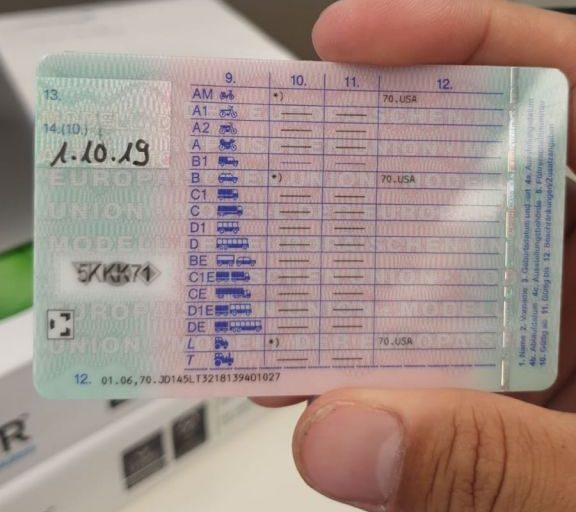
The driving licence test Germany is the official examination process used to determine whether an applicant is competent to drive a particular category of motor vehicle.
For most first-time applicants, there are two stages:
The theoretical examination assesses your knowledge of traffic regulations, hazards, environmentally responsible driving and basic technical principles.
The practical examination assesses whether you can apply your knowledge while operating the vehicle safely in real traffic.
Both are important. Passing the theory test does not automatically mean you are ready for the practical test.
The German licensing system separates theoretical knowledge from practical driving ability.
The theory examination tests whether you understand:
These subjects are specifically defined by the German Fahrerlaubnis-Verordnung (FeV).
The practical examination determines whether you can apply the required knowledge and drive safely in traffic.
For most first-time applicants, you must pass the theory test before taking the practical examination.
If you are applying for your first standard German driving licence, you will generally need to pass both the theoretical and practical examinations.
German law states that applicants normally demonstrate their competence through a theory and practical examination. There are exceptions for certain licence categories and licence extensions.
For example, the rules differ for some licence upgrades and categories such as:
Therefore, if you already hold a driving licence, you should check whether you need a complete examination process or a more limited test.
For more information, read our German Driving Licence Requirements guide.
The theory test is the first major examination for most applicants.
Its purpose is to establish whether you understand the rules and principles necessary for safe participation in road traffic.
According to Section 16 FeV, applicants must demonstrate sufficient knowledge of applicable traffic regulations, environmentally conscious and energy-efficient driving, traffic hazards and basic technical relationships relevant to road safety.
The theory examination uses questions covering different subject areas.
Depending on your licence category, questions can involve:
The questions have different point values depending on their importance for road safety, environmental protection and energy efficiency.
This means that not every incorrect answer has the same impact on your result.
For a first-time applicant for categories including AM, A1, A2, A, B, L and T, the official examination structure provides 30 questions, with a total of 110 possible points.
The permitted number of error points is generally 10. However, two incorrectly answered questions worth five points each result in failure.
This is why simply counting incorrect answers is not enough. You also need to understand the point value assigned to the questions.
Yes.
This is particularly useful for international residents who are not yet fluent in German.
The FeV provides for the theory examination to be offered in several foreign languages, including:
Therefore, English-speaking applicants can prepare for the German driving test without necessarily taking the theory examination in German.
For additional preparation advice, visit our Führerschein Theorie Lernen resources.
Good preparation is one of the strongest predictors of success.
Rather than memorising answers without understanding them, focus on the underlying traffic principles.
Your driving school provides structured theoretical instruction.
Learn not only what signs look like but also how they affect your driving behaviour.
Repeated practice helps you become familiar with the structure and terminology of the examination.
Right-of-way situations are particularly important.
You should understand how speed, visibility, weather and road conditions affect stopping distance and risk.
Do not ignore questions about vehicle technology.
Do not schedule your test simply because you have completed a certain number of practice questions.
Your goal should be consistent competence.
Explore our Führerschein Test content for additional preparation information.
Passing the theory examination is only one part of the driving licence test Germany process.
The practical examination evaluates your ability to operate the vehicle safely and apply the knowledge acquired during your training.
Under Section 17 FeV, the applicant must demonstrate the technical knowledge and practical ability necessary to safely operate the vehicle and apply environmentally conscious and energy-efficient driving principles.
The practical examination can include several stages of assessment.
These can involve:
The precise requirements depend on the licence category.
The examination structure is governed by Annex 7 of the FeV and the applicable examination guidelines.
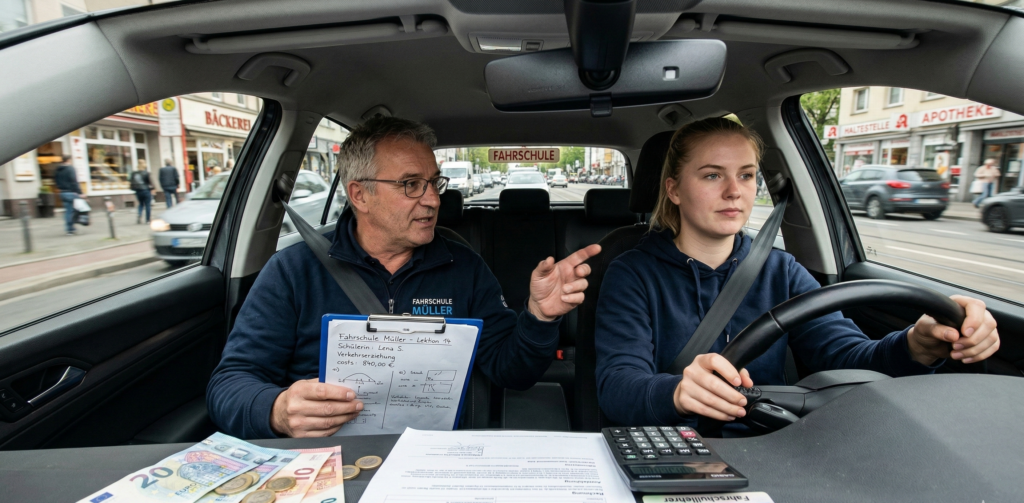
During the practical test, the examiner is interested in much more than whether you can make the vehicle move.
You need to demonstrate safe, controlled and legally compliant driving.
Important areas include:
You should continuously monitor:
Driving too fast can be just as problematic as driving unnecessarily slowly.
You should choose a speed appropriate to:
You need to correctly identify who has priority.
Your vehicle should be correctly positioned for the road and traffic situation.
You should be able to perform required manoeuvres in a controlled manner.
Proper use of indicators and appropriate interaction with other road users is important.
The examination duration depends on the licence category and applicable examination requirements.
The official rules specify examination duration and procedure through Annex 7 and the relevant examination guidelines.
The practical test should therefore not be viewed simply as a fixed period of driving around a predetermined route.
The examiner assesses the applicant’s ability across the prescribed examination components.
One of the important rules of the driving licence test Germany process is that the practical examination cannot normally be taken before passing the theory examination.
German law explicitly states that the practical test may only be taken after the theoretical examination has been passed.
The practical examination can also be taken no earlier than one month before reaching the applicable minimum age, subject to the relevant rules.
Passing the theory test does not give you unlimited time to complete the practical examination.
Under Section 18 FeV, the practical examination must generally be completed within 12 months of passing the theory examination. Otherwise, the theory examination loses its validity.
This is an important deadline for candidates.
If you have passed your theory test, do not assume you can wait indefinitely before taking the practical examination.
Failing either examination does not permanently prevent you from obtaining a German driving licence.
If you fail, you need to identify the areas that require improvement and prepare for another attempt.
German regulations generally require a waiting period before a failed examination can be repeated. A failed examination normally cannot be repeated before an appropriate period has passed, generally at least two weeks.
Your driving instructor can help identify the weaknesses that contributed to the failed test.
Many failures result from avoidable mistakes.
Not checking mirrors or blind spots properly can create serious safety problems.
Failing to recognise priority rules is a major issue.
Drivers must adjust speed to the circumstances rather than simply following the maximum permitted speed.
Incorrect positioning can make manoeuvres and interactions with other road users unsafe.
Indicators must be used appropriately when changing direction or position.
Parking manoeuvres require control, observation and accuracy.
Excessive anxiety can affect observation, decision-making and vehicle control.
You should be able to make appropriate decisions without constant instructor intervention.
There is no guaranteed method for passing on the first attempt, but effective preparation can significantly improve your readiness.
Regular driving lessons help maintain continuity.
Do not repeat the same mistake without analysing why it occurred.
Ask your instructor to focus on areas where you have difficulty.
Familiarity with local road layouts can help, although you should be capable of driving safely anywhere.
Mirror checks and blind-spot checks should become automatic.
A calm, controlled driving style is generally better than making rushed decisions.
You should be able to respond appropriately to unfamiliar situations.
Foreign applicants can face additional challenges, especially if they are unfamiliar with German traffic rules.
The good news is that international applicants can prepare systematically.
Important areas include:
If you already have a foreign driving licence, however, you should first determine whether you need to complete the German examination process at all.
Read our Foreign Driving Licence Germany guide.
It depends on your situation.
If you already hold a foreign licence, Germany may recognise or allow the exchange of that licence under applicable rules.
For EU/EEA licences, European recognition rules are particularly important.
For licences issued outside the EU/EEA, the requirements can vary according to the country of issuance and the applicable German regulations.
Some applicants may need to take the German theory and/or practical examination when exchanging their licence.
Before registering for a complete German driving course, investigate the rules applicable to your existing licence.
Learn more through our Führerschein Umschreiben Deutschland resources.
The driving licence test Germany process involves more than just examination fees.
Your total expenses can include:
The exact cost depends on your driving school, location, number of lessons and examination results.
For more information, read our Führerschein Kosten guide and our Führerschein Kosten 2026 article.
| Feature | Theory Test | Practical Test |
|---|---|---|
| Main purpose | Test traffic knowledge | Test driving ability |
| Main focus | Rules, hazards and technical knowledge | Safe vehicle operation |
| Format | Questions | Real-world driving |
| Preparation | Theory lessons and question practice | Practical driving lessons |
| Required first? | Yes | After theory |
| Failure | Retake required | Retake required |
| Language options | Several permitted languages | Driving instruction/examination arrangements differ |
German law formally distinguishes between the theoretical and practical examinations.
Use this checklist while preparing:

For most first-time applicants, there are two examinations: a theory examination and a practical examination. Certain licence categories and extensions have different requirements.
The theory examination can be taken in English because English is among the permitted foreign languages listed in Annex 7 FeV.
Generally, no. The practical examination can only be taken after the theory examination has been passed.
For a first-time applicant for Category B, the standard theory test contains 30 questions, with 110 total possible points and generally a maximum of 10 error points. Two incorrect five-point questions result in failure.
You must repeat the examination after the applicable waiting period. A failed theory examination must be repeated in full.
You can prepare for another attempt and repeat the practical examination after the applicable waiting period.
The practical examination generally must be completed within 12 months after passing the theory examination.
The test can be challenging because it evaluates both detailed traffic knowledge and practical driving competence. Thorough preparation and regular driving practice can substantially improve your readiness.
Not necessarily. If you already hold a foreign licence, recognition or exchange rules may apply depending on the country of issue and your circumstances.
The driving licence test Germany is designed to ensure that drivers possess both the theoretical knowledge and practical skills required for safe participation in German road traffic.
For a typical first-time Category B applicant, the process is:
Driving school → Theory preparation → Theory test → Practical training → Practical test → German driving licence
The theory test measures your understanding of traffic regulations, hazards and technical principles, while the practical test evaluates your ability to apply that knowledge safely on the road.
The most effective preparation is therefore not simply memorising test questions. You should understand why particular traffic rules exist and develop safe driving habits that become automatic.
If you are preparing for a driving licence test in Germany, researching German driving licence requirements, learning the theory questions or preparing for the practical examination, explore the related resources at FahrenExperten.
Driving Licence in Germany: Everything You Need to Know A driving licence is an important...
Weiterlesen
Rijbewijs kosten in Duitsland: een compleet overzicht Wie in Duitsland zijn rijbewijs wil halen, vraagt...
Weiterlesen